Product Suggestions
Featured image

DiagZone vs XDiag – Honest Comparison Based on Real Us

If you are trying to choose between DiagZone and XDiag, you are probably looking for real differences, not marketing claims. This article compares both tools based on user feedback, real-world usage, and commonly reported strengths and limitations.

No recommendations. No sales talk. Just facts.


1. What DiagZone and XDiag Actually Are

Both DiagZone and XDiag are diagnostic software platforms designed to run on Android devices using compatible OBD adapters. They are commonly used as alternatives to more expensive professional diagnostic systems.

They allow users to:

  • Read and clear fault codes
  • View live sensor data
  • Perform basic service functions
  • Access multiple vehicle modules

They are not full dealer-level tools and do not replace OEM diagnostic software.


2. User Interface and Ease of Use

DiagZone

  • Interface is functional but not always intuitive
  • Some users report inconsistent menu layouts
  • Occasional connection or login issues after updates

XDiag

  • Generally considered easier to navigate
  • Cleaner layout and better menu structure
  • More consistent language translation

Summary: XDiag tends to feel more user-friendly, especially for less experienced users.


3. Diagnostic Functions

Both platforms offer:

  • Fault code reading and clearing
  • Live data monitoring
  • Service reset functions
  • Basic adaptations

Differences noted by users:

  • DiagZone sometimes offers deeper access on certain European vehicles
  • XDiag is often reported as more stable during routine diagnostics
  • Neither tool reliably supports advanced ECU programming

Advanced coding and dealer-level functions remain limited on both.


4. Stability and Reliability

This is where opinions become mixed.

  • DiagZone users report occasional login or server issues
  • XDiag users report fewer crashes but occasional feature loss after updates
  • Both depend heavily on server availability

Neither platform is immune to update problems or temporary service interruptions.


5. Vehicle Coverage

Both tools support a wide range of vehicles, but coverage varies depending on:

  • Vehicle brand
  • Model year
  • Control unit type

In general:

  • DiagZone sometimes performs better with European brands
  • XDiag often performs consistently across Asian vehicles

Results vary depending on the car and software version.


6. Updates and Long-Term Use

Neither platform offers fully predictable update schedules.

  • Updates may improve features or remove them
  • Some users report lost functionality after updates
  • Long-term stability depends on server support

This is a common limitation with cloud-based diagnostic platforms.


7. Real-World Summary

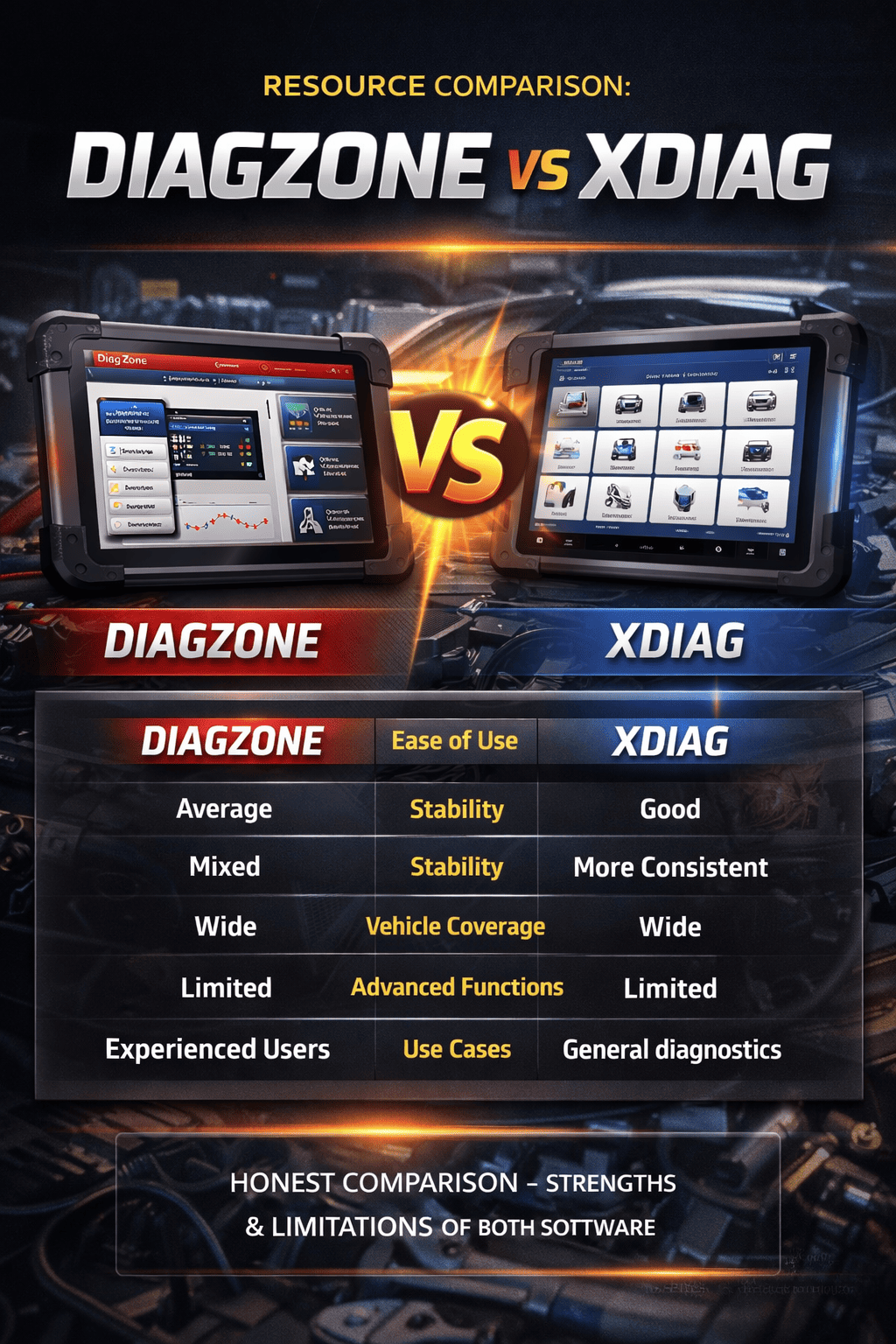
Category DiagZone XDiag
Ease of Use Average Good
Stability Mixed More consistent
Vehicle Coverage Wide Wide
Advanced Functions Limited Limited
Best For Experienced users General diagnostics

Final Thoughts

Neither DiagZone nor XDiag is objectively “better” in every situation.

They are both mid-level diagnostic solutions with strengths and weaknesses:

  • DiagZone may offer slightly deeper access in some cases
  • XDiag is generally easier and more stable for daily use
  • Neither replaces professional OEM tools

The right choice depends on your vehicle type, experience level, and tolerance for software limitations.

If you expect perfect reliability or dealer-level access, neither will fully deliver that.

If you want affordable diagnostics with reasonable capability, both can do the job.

Trustpilot

DiagZone, XDiag, HaynesPro and XPro5 Diagnostic Software Subscriptions

Modern vehicles are more computerized, interconnected and software-dependent than ever. Basic code readers often cannot access important control modules, ECU coding functions, live data, bi-directional testing or full-system diagnostics.

This guide compares professional diagnostic solutions, including Diagzone Pro, XDiag, XPro5, ThinkDiag 2 and Launch X431. It also explains important functions such as ECU coding, J2534 pass-through, bi-directional testing and manufacturer-specific diagnostics.


Why Basic OBD2 Code Readers Are Often Not Enough

Entry-level OBD2 scanners generally focus on generic engine fault codes. Depending on the vehicle and software, they may not access important systems such as:

Professional workshops may also require the ability to perform:

The availability of these functions depends on the vehicle, model year, diagnostic adapter, software version and active subscription.


What to Look for in Professional Diagnostic Software

1. Vehicle and System Coverage

A long vehicle-brand list does not always mean deep coverage. Check whether the software supports the systems and functions required for the vehicles your workshop services, including ABS, SRS, transmission, body electronics, security systems and ADAS-related functions.

2. Full-System Access

Full-system access may allow you to read and clear fault codes, view live data, perform system tests and complete adaptations. The available functions can vary between brands and vehicle models.

3. Bi-Directional Testing

Bi-directional control allows the diagnostic tool to send commands to supported vehicle components. Examples may include activating cooling fans, testing solenoids or cycling specific actuators.

4. ECU Coding and Programming

ECU coding
Adjusts configuration parameters after a module replacement, retrofit or feature change.
ECU programming
Writes or updates firmware in a control unit. This function may require manufacturer authorization, a stable power supply and additional equipment.

Coding and programming are different functions. Always confirm the exact support available for the vehicle before starting a module update or configuration procedure.

5. Updates, Licensing and Compatibility

Before purchasing a subscription, review the update schedule, renewal price, supported adapters, operating-system requirements and vehicle coverage. An adapter or dongle can also affect communication stability and diagnostic speed.


Professional Diagnostic Tools Compared

General comparison of selected diagnostic platforms
Tool Full-system diagnostics ECU coding Bi-directional testing Typical use
Diagzone Pro Available for supported vehicles Vehicle-dependent Vehicle-dependent Advanced multi-brand diagnostics
XDiag Pro3 Available for supported vehicles Vehicle-dependent Vehicle-dependent Multi-brand scanning and service functions
XPro5 Available for supported vehicles Vehicle-dependent Vehicle-dependent General workshop diagnostics
ThinkDiag 2 Software-dependent Software- and vehicle-dependent Software- and vehicle-dependent Portable diagnostics and service functions
Launch X431 Available for supported vehicles Vehicle-dependent Vehicle-dependent Professional workshop diagnostics

The features shown above are general descriptions, not guaranteed specifications. Confirm compatibility with the exact vehicle, model year, adapter and software subscription before purchasing.


Diagzone Pro

Diagzone Pro is intended for users who need multi-brand diagnostics and access to advanced functions on supported vehicles. Depending on the vehicle and subscription, features may include:

It may be suitable for independent workshops that regularly work on multiple vehicle brands. Always verify the supported functions for the specific vehicle before making a purchase.


XDiag Pro3

XDiag Pro3 is designed for multi-brand scanning, fault-code analysis and workshop service functions. Its practical use depends on the supported vehicle coverage and the selected software package.


XPro5

XPro5 is a multi-brand diagnostic solution for workshops and mobile mechanics. It can be considered by users looking for a balance between diagnostic coverage, portability and service functions.


ThinkDiag 2

ThinkDiag 2 is a compact diagnostic adapter that works with compatible software and subscription services. Available functions depend on the selected software package, vehicle and operating system.


Launch X431

Launch X431 products are used in many professional workshop environments. Different X431 models have different hardware, subscriptions and capabilities, so users should compare the exact model before purchasing.


How to Choose the Right Diagnostic Tool

The best choice depends on your vehicle coverage requirements, budget, preferred hardware and the functions you use most frequently.


Frequently Asked Questions

Can I use a basic OBD2 scanner on a modern vehicle?

Yes, for supported generic engine-related emissions codes. However, a basic scanner may not access systems such as ABS, SRS, transmission, BCM or ADAS.

Do I need ECU coding for every repair?

No. ECU coding is usually required only for certain module replacements, retrofits, configuration changes and feature activations. The exact requirement depends on the vehicle.

Which tool is suitable for a high-volume workshop?

A suitable tool should provide stable communication, fast scanning, broad vehicle coverage and the specific service functions your workshop uses. Compare the exact software version and subscription rather than relying only on the product name.

Are laptop-based diagnostic tools better than tablet-based tools?

Not necessarily. Laptop-based systems may offer specialized functions, while tablet-based tools are often more portable. The better option depends on the vehicle coverage and functions required.

How often should diagnostic software be updated?

Update frequency depends on the manufacturer and subscription plan. Check the provider's update policy and renew the software when new vehicle coverage or required functions become available.


Final Recommendation

Diagzone Pro, XDiag Pro3, XPro5, ThinkDiag 2 and Launch X431 can serve different workshop requirements. The most important factors are vehicle coverage, supported diagnostic functions, adapter compatibility, update policy and total subscription cost.

Before purchasing, check compatibility with the exact makes, models and model years that your workshop services. For ECU coding or programming, use a stable power supply and follow the manufacturer's procedure.


Further Reading