Product Suggestions
Featured image

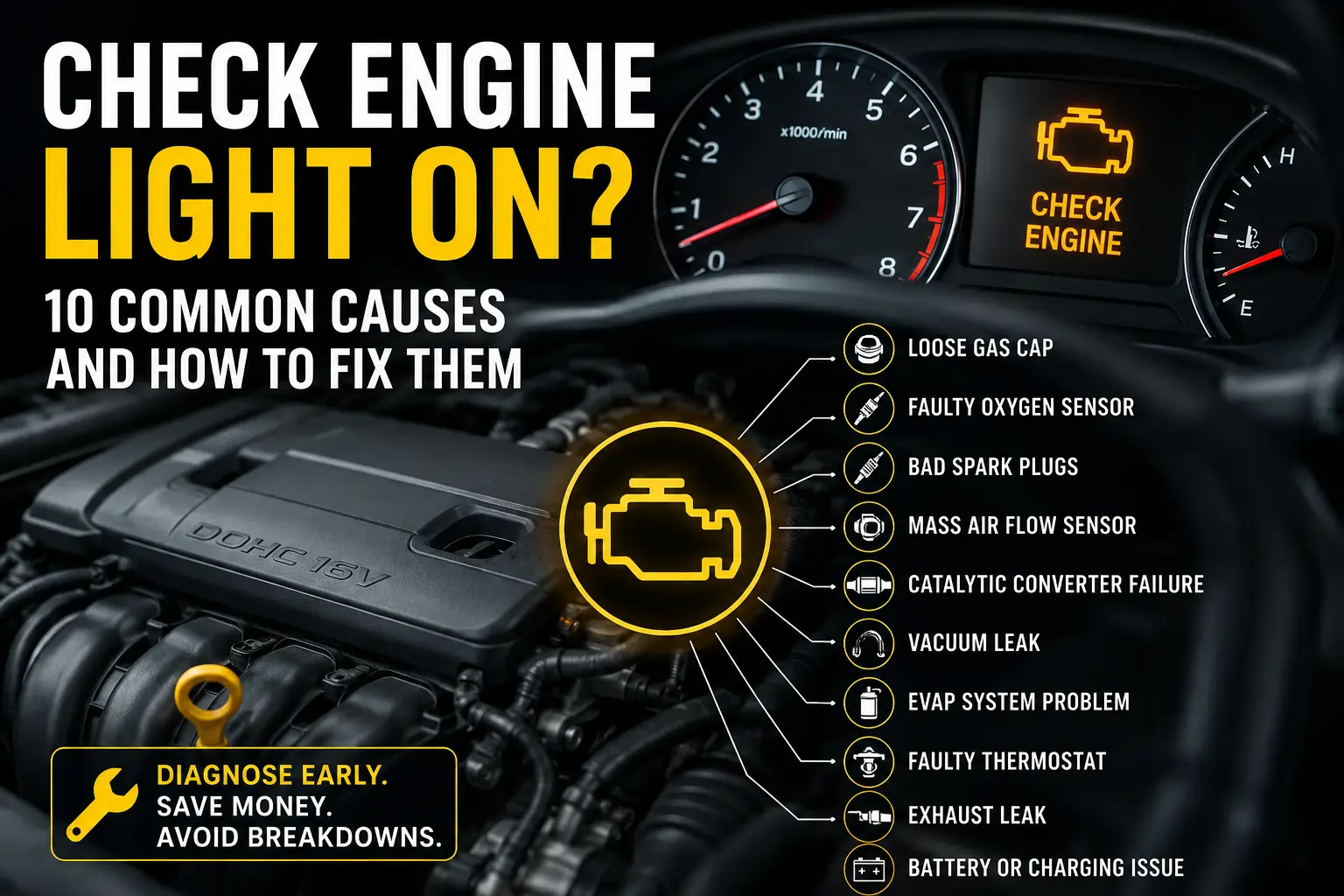
Check Engine Light On ? Here's What It Really Means

Few dashboard warnings cause more anxiety than the Check Engine Light (CEL). Whether it appears suddenly while driving or after starting your vehicle, it's your car's way of telling you something isn't working properly.

The good news is that a check engine light doesn't always mean an expensive repair. Sometimes the fix is as simple as tightening your gas cap. Other times, it may indicate a failing oxygen sensor, ignition coil, or catalytic converter.

In this guide, we'll explain the most common reasons your check engine light comes on, how to diagnose the issue, and what you should do next.


1. Loose or Damaged Gas Cap

Believe it or not, one of the most common reasons for a check engine light is a loose gas cap.

A damaged or improperly tightened cap allows fuel vapors to escape, triggering the EVAP (Evaporative Emission Control) system.

Symptoms

  • Check engine light only
  • Fuel smell around the vehicle
  • Slight decrease in fuel economy

Fix

  • Tighten the gas cap until it clicks.
  • Replace it if the rubber seal is cracked.
  • Drive for several trips to see if the light clears.

Estimated Repair Cost: $15–40


2. Faulty Oxygen (O2) Sensor

Your oxygen sensor measures the amount of oxygen in the exhaust gases so the engine computer can adjust the air-fuel mixture.

When it fails, fuel economy drops and emissions increase.

Symptoms

  • Poor fuel economy
  • Rough idle
  • Failed emissions inspection
  • Check engine light

Estimated Repair Cost: $150–400


3. Bad Mass Air Flow (MAF) Sensor

The MAF sensor tells the ECU how much air enters the engine.

If it sends incorrect readings, your engine may run rich or lean.

Symptoms

  • Hesitation during acceleration
  • Stalling
  • Rough idle
  • Reduced engine power

Repair Cost: $200–450


4. Worn Spark Plugs or Ignition Coils

Misfires are one of the most common reasons for a flashing check engine light.

Ignoring them can damage the catalytic converter.

Warning Signs

  • Engine shaking
  • Loss of power
  • Hard starting
  • Increased fuel consumption

Typical Repair Cost:

  • Spark plugs: $100–300
  • Ignition coils: $150–600


5. Catalytic Converter Failure

The catalytic converter reduces harmful emissions.

A failing converter often results from prolonged engine misfires.

Symptoms

  • Poor acceleration
  • Rotten egg smell
  • Reduced fuel economy
  • Failed emissions test

Repair Cost: $900–2,500


6. Vacuum Leak

Modern engines rely on vacuum pressure for proper operation.

A cracked vacuum hose can create lean fuel conditions.

Symptoms

  • High idle
  • Hissing noise
  • Rough running
  • Poor fuel economy

Repair Cost: $50–300


7. EVAP System Problems

Leaks in the evaporative emissions system are another common trigger.

Components that commonly fail include:

  • Purge valve
  • Vent valve
  • Charcoal canister
  • EVAP hoses

Repair Cost: $80–600


8. Faulty Thermostat

If your engine never reaches operating temperature, fuel economy suffers.

The ECU may store a code such as P0128.

Symptoms

  • Engine runs cool
  • Poor heater performance
  • Increased fuel consumption

Repair Cost: $150–450


9. Exhaust Leak

Leaks before the oxygen sensor confuse engine management.

Common symptoms include:

  • Loud exhaust
  • Ticking noise
  • Reduced performance
  • Check engine light

Repair Cost: $100–700


10. Weak Battery or Charging System

Modern vehicles rely heavily on electronics.

Low voltage from a failing battery or alternator can trigger multiple warning lights and diagnostic trouble codes.

Repair Cost:

  • Battery: $120–300
  • Alternator: $350–900


Can You Drive With the Check Engine Light On?

It depends.

Safe to Drive (Usually)

  • Light is solid
  • Vehicle drives normally
  • No unusual noises
  • No smoke

Stop Driving Immediately

  • Flashing check engine light
  • Severe shaking
  • Loss of power
  • Overheating
  • Smoke from the engine

A flashing light usually indicates an active engine misfire that can quickly damage the catalytic converter.


How to Diagnose the Problem

Instead of replacing parts at random, follow these steps:

  1. Read the diagnostic trouble codes using an OBD-II scanner.
  2. Research what the code actually means.
  3. Inspect related components.
  4. Confirm the repair before replacing expensive parts.
  5. Clear the code and test drive.


Frequently Asked Questions

Can the check engine light turn off by itself?

Yes. If the problem is temporary—such as a loose gas cap—the light may disappear after several drive cycles.

Will disconnecting the battery reset the light?

It may temporarily clear the light, but if the underlying problem still exists, it will return.

Is it expensive to fix a check engine light?

Not always. Repairs can range from a $20 gas cap to a catalytic converter replacement costing over $2,000.


Final Thoughts

A check engine light should never be ignored, but it doesn't always mean a major repair. Understanding the most common causes can help you diagnose the issue quickly, avoid unnecessary expenses, and keep your vehicle running reliably.

If your vehicle has a check engine light, use a quality OBD-II scanner, inspect the obvious causes first, and address problems before they become more expensive.


Trustpilot

DiagZone, XDiag, HaynesPro & XPro5 Diagnostic Software Subscriptions

Independent mechanics today confront vehicles that are more computerized, interconnected, and software‑dependent than ever before. If you still rely on basic code readers, you’re missing out on critical control modules, ECU coding functions, live data, bi‑directional testing, and full system coverage. This guide goes beyond generic “car diagnostic software” talk — it shows you the best OBD2 diagnostic tools mechanics should consider in 2026, including feature comparisons of Diagzone Pro, XDiag, XPro5, ThinkDiag 2, Launch X431 and key advanced functionalities like ECU coding, J2534 passthrough support, bi‑directional tests and dealer‑level diagnostics.

This is not a regurgitated list — it’s a practical, honest breakdown of what matters, where the gaps are, what tools cost, and how they perform in real workshop environments.


Why Basic OBD2 Code Readers Are Not Enough in 2026

Let’s be brutally honest: entry‑level OBD2 scanners only tell you what’s wrong at the most superficial level. They capture generic engine codes — that’s it. They fail to touch critical modules like:

If you run a professional shop or want to increase your ticket size, you need tools that do more than read codes. You need the ability to:

Workshops that skip these capabilities end up guessing, replacing parts unnecessarily, extending repair times, and frustrating customers. You cannot afford that inefficiency or reputation risk.


What Mechanics Need from Professional OBD2 Diagnostic Tools

Before we break down specific tools, you need to understand the criteria that separates pro‑grade tools from cheap scanners.

1. Broad and Deep Vehicle Coverage

Not all “multi‑brand support” is equal. Some tools claim compatibility with many brands but only read engine codes. You want tools that access every system — including security systems, ADAS modules, transmissions and body electronics — across European, Asian and American vehicles.

2. Full System Access Including ABS, SRS, BCM

Actual full system access means you can read and clear codes, perform live data monitoring, run tests and adapt modules across all systems, not just the engine. This is where most scanners fail.

3. Bi‑Directional Control and Actuator Testing

If your tool can’t physically command components (turn on a fan, cycle a solenoid, test a sensor), you’re still guessing about failures. Bi‑directional testing is essential for accurate diagnosis.

4. ECU Coding vs Programming

This distinction matters:

Both functions are required in professional environments, especially after module replacements, feature activations, or recalls.

5. Update Frequency and Licensing

Licensed and regularly updated platforms ensure compatibility with the latest vehicles and systems. Tools that stagnate can leave you behind within months.


Top OBD2 Diagnostic Tools for Independent Mechanics

The following tools represent the most powerful, widely searched and frequently discussed options in 2026 for independent shops looking for pro‑level diagnostic and coding capabilities.

Tool Full System ECU Coding Bi‑Directional Best Use Case
Diagzone Pro Yes Advanced Yes Deep dealer‑level diagnostics & coding
XDiag Pro3 Yes Moderate‑Advanced Yes Fast scanning & broad coverage
XPro5 Yes Good Yes Balanced pro tool
ThinkDiag 2 Yes Yes (varies with software) Yes Affordable all‑system tool
Launch X431 Yes Advanced Yes Professional workshop standard

Diagzone Pro — Dealer‑Level Diagnosis and ECU Coding

Diagzone Pro consistently ranks among the most powerful tools for independent shops that need deep diagnostics and coding capabilities. It offers:

For independent mechanics planning to handle complex faults, security systems and ADAS calibrations, Diagzone Pro remains one of the most complete options available outside of brand‑specific dealer tools.


XDiag Pro3 — Fast, Reliable Multi‑Brand Scanning

XDiag Pro3 is built for speed and efficiency without sacrificing depth. It excels in:

If you operate a high‑volume workshop and don’t need the deepest dealer‑level coding on every brand, XDiag often provides the best balance of performance and speed.


XPro5 — Balanced Professional OBD2 Diagnostic Tool

XPro5 sits between Diagzone and XDiag in terms of depth and usability. It provides:

This makes XPro5 ideal for shops that want professional capabilities without the steep learning curve or higher cost of some dealer‑level platforms.


ThinkDiag 2 — Affordable Full System Diagnostic Tool

ThinkDiag 2 is frequently mentioned in searches because it combines affordability with true full system diagnostics. When paired appropriately with software suites like Diagzone or XDiag, it supports:

ThinkDiag 2 is especially appealing for mobile mechanics or startups looking to avoid huge upfront investment while still accessing powerful diagnostic capabilities.


Launch X431 — Established Professional Standard

Launch X431 has been a mainstay in professional shops and diagnostic houses for years. Its strengths include:

Launch X431 is often paired with rugged tablets and professional hardware, making it a dependable choice for full‑time diagnostic work.


ECU Coding vs ECU Programming — What You Really Need

Confusion around ECU functions costs workshops money. Here’s the honest difference:

Mechanics must understand both, and choose tools that support the functions actually needed for the vehicles they work on. Without proper coding or programming support, fault codes may reset temporarily but issues will return, or systems will malfunction.


What to Look For in OBD2 Diagnostic Tools

Here’s the reality: marketing claims rarely align with real capability. When evaluating tools, focus on these criteria:

System Coverage Depth

Don’t just look at brand lists — check whether the tool supports:

Bi‑Directional Actuator Tests

If your tool cannot physically command components, you don’t have real diagnostics — you’re still guessing.

Live Data & Graphing

Modern faults often require comparing real sensor values over time. Tools without graphing capability will slow you down and increase diagnosis risk.

Update Frequency

An expensive tool with stale data is worse than a cheaper tool with frequent updates. Always check update policy and renewal cost.

Hardware Compatibility

The adapter (dongle) influences stability, speed, and reliability. Choose adapters known for robust ECU communication — cheap ELM327 clones are not acceptable for professional work.


Common Search Keywords Mechanics Should Target

To improve visibility and drive traffic, content should naturally integrate the following terms:

Integrating these into headings and paragraph content improves search engine relevance for real user intent queries.


Frequently Asked Questions

Can I use a basic OBD2 scanner for modern vehicles?

No — basic scanners only read engine codes and cannot access all systems like ABS, SRS, transmission, BCM or ADAS.

Do I need ECU coding for all repairs?

Not for basic maintenance — but essential for module replacements, retrofits, and feature activation. Without proper coding, systems may malfunction or throw warning lights.

Which tool is better for high‑volume workshops?

For speed and breadth, XDiag or XPro5 is often better. For deeper diagnostics and specialized coding — Diagzone Pro or Launch X431.

Are laptop diagnostic tools better than tablet‑based ones?

Laptop tools often provide more advanced features but require a stable workspace. Tablet and mobile solutions are more flexible for field work.

How often should I update my diagnostic tool?

Regular updates — annually at a minimum — are critical to maintain compatibility with new car models and systems.


Final Verdict: What Independent Mechanics Should Choose

Choosing the right OBD2 diagnostic tool depends on what your workshop needs:

Pair your chosen diagnostic platform with reliable adapters and regular updates, and your shop will be equipped to handle modern vehicles confidently and profitably in 2026 and beyond.

To maximize authority, link this page to related articles on your site: