
P0420 Code: Causes, Symptoms and How to Diagnose It
Have you scanned your vehicle and found P0420? This OBD2 trouble code means the engine computer has detected that the catalytic converter is not cleaning the exhaust gases as efficiently as expected. The code is common, but the correct repair is not always “replace the catalytic converter.”
In this guide, CarFaultFix explains the P0420 meaning, common symptoms, likely causes and a professional diagnostic process. Whether you are a vehicle owner, mobile mechanic or workshop technician, the goal is simple: identify the real fault before spending money on unnecessary parts.
What Does the P0420 Code Mean?
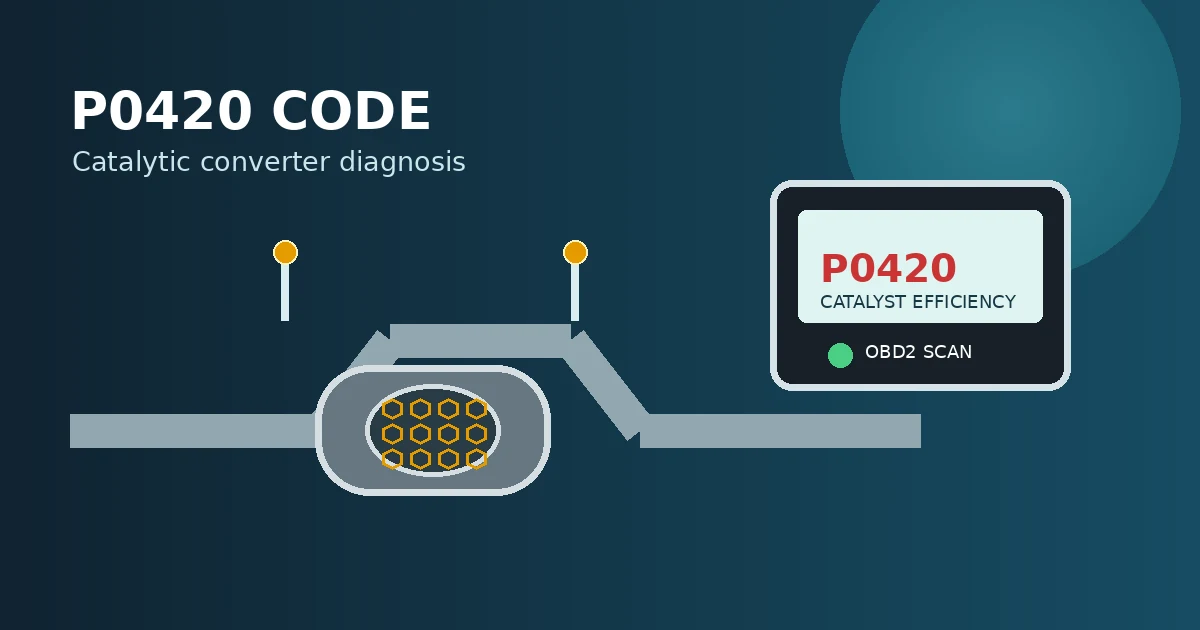
The catalytic converter is part of the exhaust system. Its job is to help reduce harmful emissions by converting pollutants into less harmful gases. To monitor its performance, the vehicle normally compares readings from an upstream oxygen sensor, located before the converter, with a downstream oxygen sensor, located after it.
When the downstream sensor signal looks too similar to the upstream signal for the required conditions, the engine control module may decide that the converter is not storing and processing oxygen effectively. It then records P0420 and may switch on the check engine light.
“Bank 1” identifies the side of the engine containing cylinder number one. On an inline four-cylinder engine there is usually only one bank. On a V6 or V8, bank identification matters because the vehicle may have a separate code for the other side.
Common P0420 Symptoms
Some vehicles show only a check engine light and drive normally. Others may have additional symptoms, especially when the underlying problem has been present for a long time.
- Check engine light or emissions warning light.
- Reduced fuel economy.
- Loss of power, especially under load, if the converter is restricted.
- Exhaust smell similar to rotten eggs.
- Failed emissions or inspection test.
- Rattling from a damaged converter substrate.
- Additional misfire, fuel-trim or oxygen-sensor trouble codes.
Most Common Causes of P0420
| Possible cause | Why it can trigger P0420 | What to check |
|---|---|---|
| Worn catalytic converter | The converter no longer stores oxygen and reduces pollutants effectively. | Sensor data, temperature behaviour, exhaust restriction and vehicle history. |
| Exhaust leak | Outside air can enter the exhaust and distort oxygen-sensor readings. | Leaks near the manifold, flex pipe, gaskets and sensor threads. |
| Faulty oxygen sensor | A slow, biased or contaminated sensor can report incorrect exhaust information. | Live data, response time, wiring, heater circuit and sensor codes. |
| Engine misfire | Unburned fuel can overheat and damage the converter. | Misfire counters, ignition components, injectors and compression. |
| Rich or lean air-fuel mixture | Incorrect fueling prevents the converter from operating normally. | Short- and long-term fuel trim, vacuum leaks, MAF/MAP readings and fuel pressure. |
| Oil or coolant consumption | Contaminants can poison or damage the catalyst over time. | Smoke, fluid loss, crankcase ventilation and internal-engine condition. |
How to Diagnose P0420 Step by Step
1. Scan all available modules
Start with a complete vehicle scan, not only the engine module. Record every stored, pending and history code. Repair active misfire, fuel-mixture or oxygen-sensor faults first because they can create or accelerate a catalytic-converter problem.
2. Check the vehicle information
Confirm the exact vehicle, engine, model year and bank location. Check whether the vehicle has recent exhaust work, an aftermarket converter, a software update, collision damage or a history of overheating and misfires.
3. Inspect for exhaust leaks
Inspect the exhaust manifold, gaskets, flex pipe, catalytic-converter joints and oxygen-sensor fittings. A small leak before the downstream sensor can introduce oxygen and make a healthy converter appear inefficient.
4. Review live oxygen-sensor data
With the engine at operating temperature, compare the upstream and downstream sensor behaviour using a capable OBD2 diagnostic tool. The upstream sensor normally changes more actively as the engine adjusts the mixture. A downstream signal that closely follows the upstream pattern can support a catalyst-efficiency fault, but sensor type and vehicle strategy must be considered.
5. Check fuel trims and engine operation
Look at short-term and long-term fuel trims, coolant temperature, airflow readings and misfire data. Large fuel-trim corrections, unstable temperature readings or a persistent misfire should be diagnosed before condemning the catalytic converter.
6. Test for restriction when power is low
If the vehicle has poor acceleration, excessive heat or a rattling converter, check for exhaust restriction using the correct workshop procedure. A restricted converter can damage the engine and should not be ignored.
Can You Drive With P0420?
Short-distance driving may be possible when the vehicle runs smoothly and there are no flashing warning lights, severe power loss or overheating symptoms. However, continuing to drive for a long time without diagnosis can turn a small engine or sensor fault into expensive converter damage.
How Much Does P0420 Repair Cost?
The cost depends on the real cause, vehicle and parts quality. A loose connection, exhaust leak or sensor problem may cost much less than a catalytic-converter replacement. Before approving an expensive repair, ask for the scan results, related-code check, exhaust inspection and explanation of why the converter has been confirmed as faulty.
Do not choose a converter only by the lowest price. The part must be suitable for the vehicle and local emissions requirements. An incorrect or low-quality converter may trigger the code again and may not meet inspection standards.
Can Clearing P0420 Fix the Problem?
Clearing the code only removes the stored diagnostic information and turns off the warning light temporarily. If the fault remains, the engine computer may run its catalyst monitor again and switch the light back on after the required drive conditions are met.
A better approach is to save the original scan, repair the confirmed cause, clear the code, complete the appropriate drive cycle and rescan the vehicle. Always follow the manufacturer’s testing requirements for the specific model.
Choosing an OBD2 Tool for P0420 Diagnosis
A basic code reader can display P0420, but a professional multi-brand diagnostic platform can provide much more useful information: complete module scans, live oxygen-sensor data, fuel trims, misfire counters, graphing and service information. These functions help a technician test the system instead of guessing from one code.
For workshops working on different makes and models, the right diagnostic software should be matched to the adapter, vehicle coverage and functions required. CarFaultFix provides diagnostic software subscriptions for platforms such as DiagZone, XDiag, XPro5 and HaynesPro. Check the relevant product page for current compatibility and activation information before purchasing.
Frequently Asked Questions
Is P0420 always a bad catalytic converter?
No. An exhaust leak, oxygen-sensor issue, wiring fault, misfire or air-fuel problem can also trigger the code. Diagnose the complete system first.
Can a bad spark plug cause P0420?
Yes, an ongoing misfire can send unburned fuel into the exhaust and damage the catalytic converter. Misfire codes and live misfire data should be checked.
Will a fuel additive permanently fix P0420?
Do not rely on an additive as a diagnosis or guaranteed repair. If the converter is worn or the engine has a misfire, the underlying problem still needs to be corrected.
What should I repair first: P0420 or another code?
Repair active misfire, fuel-mixture, temperature, intake and oxygen-sensor faults before evaluating P0420 again. Related faults can produce misleading catalyst data.
Final Takeaway
P0420 is a warning that the catalyst-monitoring test has detected low efficiency on bank 1. It is an important clue, not an automatic instruction to replace the catalytic converter. A structured diagnosis—full scan, leak inspection, live-data review, fuel-trim checks and restriction testing—can prevent unnecessary parts replacement.
Need a reliable tool for multi-brand diagnostics, live data and advanced testing? Explore the diagnostic software options at CarFaultFix and choose the platform that matches your vehicles and workshop needs.